|
|
|
COURSE DESCRIPTIONAlmost every day we hear
news reports of economic problems and successes
from around the world. All over the world,
countries are undertaking economic reforms
(often called GLOBALIZATION or STRUCTURAL
ADJUSTMENT POLICIES) that their leaders believe
will provide their citizens with lower
unemployment and higher living
standards. This course will cover the
area of economics commonly defined as
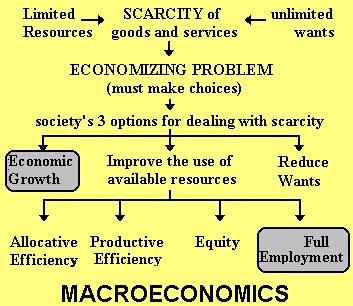
macroeconomics. The main goal of
macroeconomics is to gain a better understanding
of the causes of, and remedies for, UNEMPLOYMENT
and INFLATION, as well as the factors that
affect ECONOMIC GROWTH (unemployment, inflation,
and economic growth). We will study these
macroeconomic issues in an international context
to try to understand the economic reforms many
countries are undertaking. For more information see:
The
5Es of Economics
The basic structure will be:
|
COURSE MATERIALS |
||||||||||||||||||||||||||||||||||||||||||||||||||||||||||||||||||||||||||||||||||||||||||||||||||||||||||||
REQUIRED: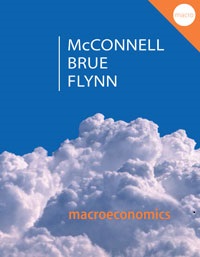 |
Macroeconomics
by Campbell R. McConnell, Brue, and Flynn, 20th
edition, McGraw-Hill, 2015
|
REQUIRED: |
Tomlinson Videos on ThinkWell BUYING the Tomlinson
Videos on ThinkWell
USING the Tomlinson Videos on Thinkwell:
Finally, you will want to have the VIDEO NOTES handy when you are watching the videos |
REQUIRED:
|
The Yellow Pages are packet of worksheets. We will do many of the graphing exercises in class and some of the Quick Quizzes. You will not get points for doing them, but I think you will find them very useful while you prepare for the quizzes and exams. The Yellow Pages are available to you for free in class or on our Blackboard site. Answers to the Yellow Pages are also available on Blackboard. Make sure you CHECK YOUR ANSWERS. |
USEFUL:
|
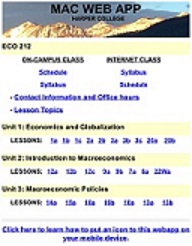
MAC WEB APP: The MacWebApp has all of the information found on our LESSONS page. How to put an icon to the app on the homescreen of your mobile device:
The app is not designed to replace your textbook, computer, or paper and pencil. To learn the class material you will have to read the textbook, watch the Tomlinson video lectures, and DO PROBLEMS. When doing problems you will need to use pencil and paper. The app is designed to introduce you to the lesson topic and show you what you need to learn. It will also help you do a quick review after you have studied the material. The app is organized according our twenty-five lessons. For each lesson you will usually find a quick introduction, an interesting topic, the reading and video assignments, Key Term Flashcards, a quick review quiz, key graphs, and YouTube review videos. Be sure to put an icon to the app on your mobile devices !!! |
BLACKBOARD, WEBSITES, E-MAIL |
All students must log-in to our Blackboard website, study the syllabus, and take the required 5-point, online, "Syllabus Quiz".Blackboard Instructions:
Always use the Google Chrome browser when using Blackboard (download for free at: Google Chrome)
- Go to http://harper.blackboard.com
- Follow the instructions to "log-in",
- If you need help see the Student Service Desk link below the Login button..
- You should see "ECO 212-003 - MACROECONOMICS (Fall 2018)" in the "My Courses" box. If you do not please e-mail the instructor: mhealy@harpercollege.edu
When e-mailing your instructor always put "ECO 212" and a message in the subject line. Please use proper spelling, punctuation, and grammar.Option to Forward Mail from your Harper E-mail Account
If you are not planning on using your Harper email account, you can find instructions on how to forward email from that account to one you check frequently by logging in to the Harper Student Portal and clicking on the "My Harper E-Mail" tab. All correspondence in this class will be sent to your harper e-mail account. All correspondence in this class will be sent to your Harper e-mail account.
Click on TEXTBOOK WEBSITE, then select a chapter from the "Choose One" drop-down menu.
The final grade for the class will be awarded according
to the following point system. Changes may be made to
this grading policy. All changes will be announced in class
and posted on Blackboard.
GRADING
Activity Number and
Points Total
Points Approximate % of
Total 1 syllabus
quiz 5 points 5 points 1 % Prequizzes 24 @ 2 points
each. 48 points 15 % Required
Activities 15 @ 1 point each 15 points 5 % Papers 3 @ 10 points
each. 30 points 10% 3 comprehensive unit
exams Unit 1: 40 points 135 points 43 % Comprehensive Final
Exam 80 multiple choice questions,
COMPREHENSIVE 80 points 25 % | | TOTAL: 313
POINTS
Unit 2: 45 points
Unit 3: 50 points
The syllabus quiz, prequizzes, required activities, papers, and unit exams can be retaken or re-written. See below for details.
Extra Credit: Each of the three unit exams will also have an extra credit essay question worth 3 points. For more information see the EXTRACREDIT link on Blackboard.
Letter Grades: Letter
grades will be awarded as follows: 100-90%=A, 89-80%=B,
79-70%=C, 69-50%=D, below 50%=F.
Letter grades may be "curved" down a little. Our
goal is for students with similar scores get similar grades.
So scores are ranked from highest score to lowest and I look
for gaps. So, if there are students at 91%, 90%, and 89%,
but then the next student is at 85%, I will move the A grade
down to 89%.
Exam Retake Scores: Exam Retake scores will NOT be included in your "My Grades" total on Blackboard. If your retake score is higher I will add the extra poInts before I assign grades at the end of the semester.
Syllabus Quiz (5 points): The syllabus quiz will be taken online via our class Blackboard site. It can be taken as many times as you wish. See schedule. Only the highest score will count.
Prequizzes (2 points each day of class): BEFORE CLASS a short quiz must be taken that will cover the material in the assigned video lectures and textbook readings. See the SCHEDULE for the date of each lesson prequiz. Some prequizzes can be taken three times, some can only be taken twice. All prequizzes must be finished by 12:00 noon the day of the lesson. After that they will no longer be available. Once you have completed a prequiz and when it is no longer available you can still access your results by going to MY GRADES on Blackboard and clicking on your score. This could be helpful when studying for exams.
Required Activity (1 point for each chapter): The "Required Activities" are to be taken on Blackboard after we have competed each chapter. They usually consist of about 20 multiple choice questions. They can be taken as many times as you wish and only the highest score will count. Required activities for each unit should be finished BEFORE the unit exam. In order to be allowed to take a unit exam retake (see below), you must have finished all the unit's required activities BEFORE the unit exam.
Papers (3 at 10 points each) Papers can be rewritten for full credit with the following restrictions:
For more information see PAPERS.
Exams (NOTE: All exams are compreshensive)
Prequizzes:
Prequizzes are worth 2 points a day (total 48 points or approximately 15% of the total grade). These must be completed before 12:00 noon on the day of class. See the SCHEDULE for the date of each lesson prequiz. No make-ups are allowed. "Stuff" happens. GET AHEAD! Some prequizzes can be taken only twice and some can be taken three times.
Exams:
If a student must miss taking an exam at the scheduled time taking the retake exam is their only option. They may be allowed to take the RETAKE exam IF:1. the instructor is notified BEFORE the scheduled exam time AND
2. the student has a very good reason to miss the exam at the scheduled time.
Required Activities:
These can be taken as many times as necessary. Only the highest score will count.
Papers:
Class attendance is strongly recommended, but not required. Former students have indicated that the material covered in class is very helpful at the time of the examinations.
| | | | 8/29-
2a 9/3 Labor
Day 9/26 Exam
1 10/15
- 9b - --
last day for paper 1 or
rewrites 10/29
Review 10/31 Exam
2 11/12
- 16a 11/21 No
Class 12/3 Exam
3 12/5 Review 12/10 Final
Exam Optional Exam 3
retake: 12/12
DAILY
SCHEDULE OF LESSONS, EXAMS, and
ASSIGNMENTS
LAST DAY TO DROP THE CLASS: Monday, 11/19
- Syllabus Quiz
- last day for paper 2 or
rewrites
- last day for paper 3 or rewrites
- 1:45-3:30 J253
-Study
Guide
9:55-11:40 J253
Optional Exam 3 retake:
1:45-3:30 J253 -
BRIEF COURSE
OUTLINE / OFFICIAL STUDENT OUTCOMES
IMPORTANT: We may not read the whole chapter or a "chapter" may include pages from other chapters, so always check the LESSONS or MacWebApp page before reading
BRIEF COURSE OUTLINE
UNIT 1 - WHAT IS ECONOMICS and GLOBALIZATION
Ch. 1
Introduction to Efficiency and to the Study of Economics
Ch. 2
The Role of Government in the Global Economy
Ch. 3
Efficiency and Markets: Supply and Demand
Ch. 20
Efficiency, Specialization, and Exchange (Trade)
UNIT 2 - INTRODUCTION TO MACROECONOMICS
* Chapter 22W is online at:
Ch. 12
A Model of the Macro Economy: AS and AD
Ch. 6
An Introduction to Macroeconomics
Ch. 9
Business Cycles: Unemployment and Inflation
Ch. 7
Measuring Domestic Output
Ch. 8
Economic Growth
Ch. 22 W*
The Economics of Developing Economies
UNIT 3- -MACROECONOMIC POLICY
Ch. 14
The Money Market
Ch. 15
How Banks Create Money
Ch. 16
Monetary Policy
Ch. 10
The Spending Multiplier
Ch. 13
Fiscal Policy
NOTE: This outline may be changed. All changes will be posted on the Blackboard announcements, announced in class, and sent via e-mail.
OFFICIAL STUDENT OUTCOMES
The student should:
- understand the basic functions and operations of a capitalist economic system (review of microeconomics.) (I-A-H)
- understand basic economic measurements. (II-A)
- understand basic Keynesian theory. (II-B)
- use AD/AS tools to investigate macro effects. (II-B)
- explain the effects of fiscal policy. (II-C)
- familiar with the origin and functions of money and banks. (III-A)
- understand money creation by the banking system. (III-B)
- know the functions and powers of the Federal Reserve System and the basics of monetary policy. (III-C)
- understand the equation of exchange and the monetarist approach to policy. (III-D)
- be familiar with alternative theories. (IV)
- understand the basics of growth, in particular: capital formation (human and physical), technology, and political/social institutions. (V)
- understand the principle of comparative advantage. (III-A)
- understand the issue of free trade vs. protectionism. (III-B)
- understand the factors determining exchange rates. (III-C)
OTHER USEFUL INFORMATION |
A few textbooks and study guides have been placed on reserve in the library in case you leave yours at Grandma's house. Some can be checked out from the circulation desk for two days at a time and one is for in-library use only.
This is a difficult course! There is an old rule of thumb concerning studying for college courses: on average students should study TWO hours for every ONE hour of class. This is an average, which means some courses require more study time and some less. You may find that economics requires MORE.The following suggestions should help you learn economics:
- GET AHEAD! There will be assignments for each day of class. You should try to be at least one to two days (one week) ahead. See the LESSONS and the SCHEDULE.
- STUDY. This is a difficult course! There is an old rule of thumb concerning studying for college courses: on average students should study TWO hours for every ONE hour of class. Since this is a 3 credit-hour course you should plan to study microeconomics 6 hours per week. This is an average, which means some courses require more study time and some less. You may find that economics requires more.
- BEFORE CLASS EACH DAY: (a) begin with the LESSONS webpage, or the Mac Web App, to read the "Introduction" and "Something Interesting", (b) watch the video lectures, (c) read the assigned readings, (d) take the prequiz, and (e) learne the lesson vocabulary (see the Key Term Flashcards,.
- READ THE BOOK! Passive reading of the textbook is not very helpful. Read with a pen in your hand and a notebook on which to list, repeat, copy, calculate, etc. ALSO, pay close attention to the TABLES and GRAPHS. THEY ARE IMPORTANT. Many students do not read the textbook and many students fail the class or withdraw. I believe the two are related.
- WATCH THE VIDEOS! Passive watching of the video lectures is not very helpful either. Most of the Tomlinson videos have an online review quiz (Thinkwell Exercise), transcripts, and lecture notes. Use them. Also, I have watched each of the assigned video lectures and taken my own notes. These VIDEO NOTES are available on our Blackboard site. Once you log in to the Thinkwell class site click on the "Chapter Checklist" link for a list of the videos by their number. Many students do not watch and many students fail the class or withdraw. I believe the two are related. Students have told me that the videos are VERY HELPFUL. If you want a good grade then watch the videos.
- ATTEND CLASS Come to class each day and come prepared to work. You will get a lot of your studying done during class. Please don't be late. NO CELL PHONES can be used in class.
- DO PROBLEMS. If you don't do the problems you will do poorly on the quizzes and exams.
Many are available on our Blackboard site. Begin with the REQUIRED ACTIVITIES (since you earn points for doing them) and the YELLOW PAGES. Then, do other exercises that can be found on Blackboard. Also, there are review quizzes (THINKWELL EXERCISES) for most of the online video lectures (VIDEO LOGIN).
- GET HELP
- See the instructor during office hours.. This should be done EARLY in the semester.
- Ask questions in class and on the Blackboard Discussion Board.
- The Tutoring Center also offers help.
- You may also want to make use of SUCCESS SERVICES FOR STUDENTS AT HARPER COLLEGE (see below).
- GET AHEAD - Or at least keep up. It is easy to get behind. To get a good grade you will have to devote a significant amount of out of class time to studying economics. If you get behind there simply will not be enough time.
- APPLY the concepts learned in class to the "real world" including issues in the news and aspects of your personal life.
Make the most of your college experience this semester by visiting Success Services for Students. Be aware of your academic needs and work to effectively change behaviors to improve academic success. Schedule an appointment for one of the following free sessions: Study Skills, Test Taking Tips, Time Management, Memory, Motivation, Test Anxiety, Reading Strategies, Math Strategies, Note Taking Skills, Concentration, Study Behavior Inventory, Learning Styles, Test Performance Analysis, Accounting Tips, Economics Tips, Preparing for Finals, and Online Study Tips.Stop by F-110, call 847.925.6715 or email success@harpercollege.edu to schedule an appointment.
https://www.harpercollege.edu/academics/academic_support/index.php
Your success in this class is important to me. If you have a disability (learning, physical, psychological or other) and may require some accommodation or modification in procedures, class activity, instruction, requirements, etc. please contact me early in the semester so we can refer you to ADS who will discuss and arrange for reasonable accommodations. The Access and Disability Services department is in the Building I, I-103, 847.925.6266 or TTY (847) 397-7600
William Rainey Harper College provides equal opportunity in education and does not discriminate on the basis of race, color, religion, national origin, age, marital status, sexual orientation, or disability.
All notifications related to student registration or other business activities are sent to students via a G-mail account that is assigned to students upon registration. Students access the G-mail account via an icon in the student portal (where you registered for classes). Please check this e-mail frequently. To forward e-mails from this account to a personal e-mail account please follow the instructions for forwarding Harper e-mail available at http://harper.blackboard.com/
Harper College is strongly committed to the promotion of high ethical standards. Such standards can best be accomplished in an environment where honesty and integrity are practiced. For this reason the College strongly condemns academic dishonesty. Academic dishonesty includes cheating, plagiarism or other improper appropriation of another's work as one's own and falsifying records to advance one's academic standing.
Cheating includes but is not limited to copying answers, stealing and/or disseminating tests or answer keys, using someone else's data in preparation of reports or assignments, and assisting others in such practices.
Plagiarism involves the presentation of another person's words, ideas, or work as one's own. It includes but is not limited to copying any material (written or non-written) without proper acknowledgment of its source, and paraphrasing another's work or ideas without proper acknowledgment.
Falsifying records includes but is not limited to falsifying or improperly altering college records and documents, or knowingly supplying false or misleading information to others (e.g., the College, other educational institutions, or prospective employers).
Any form of academic dishonesty as defined by the faculty member or department is a serious offense requiring disciplinary measures. Discipline for academic dishonesty involving a specific course shall be first determined by the instructor of the course and may include failure of the specific assignment, project or test, or failure of the course. The student may appeal the instructor's decision in accordance with the College's Student Academic Complaint Procedures. In cases of academic dishonesty the faculty assigned grade supersedes a student-initiated withdrawal. In cases where disciplinary measures beyond course failure may be deemed appropriate by the instructor, or dishonesty that is not related to a specific course, the student may be disciplined in accordance with the Student Conduct Policy with the appropriate vice president involved in the decision.