|
Because of scarcity we must make
choices. An "economic system" is the way that societies make
economic choices. Because of scarcity all countries must
decide (1) what to produce, (2) how to produce, and (3) who
get what is being produced. Economic systems answer these
fundamental questions.
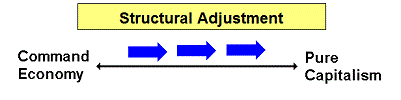
All over the world economies are
undergoing a process that I like to call "structural
adjustment", but it is more commonly called "globalization".
That is, countries are moving away from a command economy
with government central planning to a laissez-faire market
economy or capitalism. In this process the economic role of
government is decreasing all over the world (well, almost).
In order to understand why this is
happening we have to study unit 1, chapters 1, 2, 3 and 20,
which are really MICROeconomic chapters. Strangely our
Tomlinson videos do not discuss in depth the characteristics
of market economies but our textbook does (chapter 2). Our
textbook does not spend much time discussing command
economies (planned economies), or economies in transition
from planned to market (from command to capitalism), but the
video lectures do!
When studying chapter 2, both the
textbook and the videos, try to understand the following:
(1) What are the characteristics of market and command
economies? (2) What are their benefits and problems? and,
(3) Why are countries moving away from a command economy
toward a market economy?
In lesson 2a we will examine those
questions. Then, in lesson 2b, we will look at what the role
of government should play in a market economy. All over the
world the economic role of government is decreasing, but it
is not disappearing. So, what IS the economic role of
government in market economies?
|
