|
We now begin unit 3 where we focus on
macroeconomic POLICY. When we say "policy" we mean
"government". What can the government do to achieve the
three macroeconomic goals of low UE, low IN, and rapid EG?
In lesson 12c we introduced stabilization policies: monetary
policy and fiscal policy. (This would be a good time to
review your notes on lesson 12c.) Here, we will dig deeper,
beginning with Monetary Policy (MP).
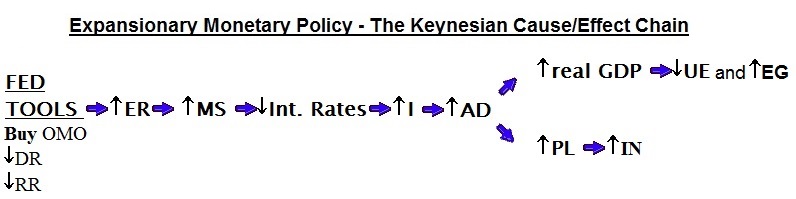
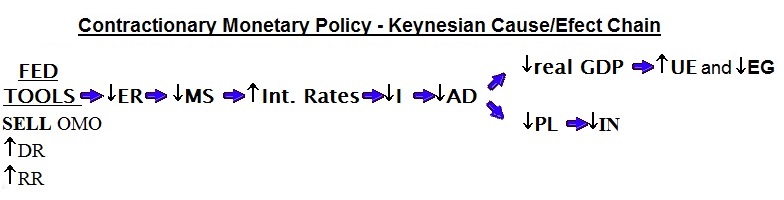
In lesson 12 c we learned that if UE
is high we can increase the money supply (MS) which will
cause interest rates to go down. We called this an "Easy
Money Policy". Lower interest rates will increase investment
(I) and therefore increase aggregate demand (AD). When AD
increases it will increase real domestic output (RDO or real
GDP) and decrease UE. But, it may increase the price level
(PL) and therefore increase inflation.
We begin monetary policy in lesson
14a by defining money (what is money?) and the money supply
(MS). Then we will develop the model (graphs) of the money
market that we will use in the next three chapters to show
how monetary policy works. We finish the lesson with a
discussion of the structure of the Federal Reserve (the
Fed). As we know from lesson 12a the Fed controls the money
supply (MS). Here we learn that "the Fed" is NOT the
federal government in Washington DC.
The policy making arm of the Fed is
basically the Federal Open Market Committee (FOMC) comprised
of 12 people and these 12 people have the power to raise
interest rates and put millions of people of work as they
did in the early 1980s. Or, the FOMC can lower interest
rates causing millions of people to earn less on their
financial investments. The chairperson of the Fed (Jerome
Powell in 2018) has been called "the second most powerful
person in the United States". In this unit we will learn
why.
|
