OUTLINE -- Chapter 4 --pp. 71-80

The Role of the Government in Market Economies

I. Structural Adjustment Policies

1. Privatization
2.
Promotion of Competition
3. Limited and Reoriented Role for Government
4. Price Reform: Removing Controls
5.
Joining the World Economy
6. Macroeconomic Stability

II. Review: Capitalism, Markets, and Efficiency

A. Capitalism and Limited Government
  1. private property and economic growth
  2. markets and prices
  3. role of self interest
  4. freedom of enterprise and choice
  5. competition = capitalism
  6. limited role for government

B. Why limited government?

I. REVIEW

A. The Market System and Efficiency
See: The supply and demand model and allocative efficiency
1. WHAT WE GET:
a. Goal of businesses: Maximize Profits
b. Therefore,they will produce where:
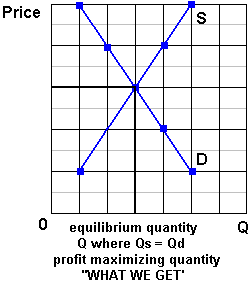
  • the Market Equilibrium quantity
  • the quantity where Qs=Qd
  • the is "what we get"


  • Graphically:

c. Assumptions: pure capitalism (for what is capitalism see: chapter 2)

2. WHAT WE WANT: ALLOCATIVE EFFICIENCY

a.. Review :
(1) Allocative Efficiency
definition - using our limited resources to produce:
  • The quantity of goods and services that maximizes society's satisfaction
  • using resources to produce more CDs that people want and fewer cassette tapes that they don't want
  • no shortages and no surpluses

(2) Benefit-Cost Analysis

definition -
the selection of ALL possible alternatives where the marginal benefits are greater than the marginal cost

select all where: MB > MC
up to where: MB = MC
but never where: MB < MC

B. Allocative Efficiency is achieved where:

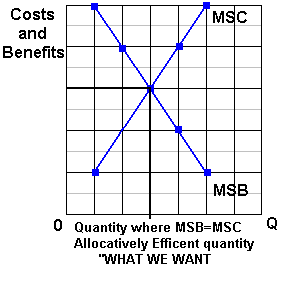
1. MSB=MSC
a. define Marginal Social Benefits (MSB)

b. define Marginal Social Costs (MSC)

c. therfore if society gets

all quantities where: MSB > MSC
up to where: MSB = MSC
but never where: MSB < MSC

this will be the quantity where society's Satisfaction will be maximized or the allocatively efficient quantity

2. Graphically:


C. THEREFORE:

1. Businesses will produce the profit maximizing or market equilibrium quantity - the quantity where Qd=Qs

2. Society wants the allocatively efficient quantity - the quantity where MSB=MSC

3. WHAT WE GET = WHAT WE WANT if:

b. Market Demand = Marginal Social Benefits (D=MSB)
1. law of diminishing marginal utility
2. assuming no positive externality (or spillover benefit)s D=MSB

c. Market Supply = Marginal Social Costs (S=MSC)

1. law of increasing costs
2. assuming no negative externality (or spillover cost)s S=MSC

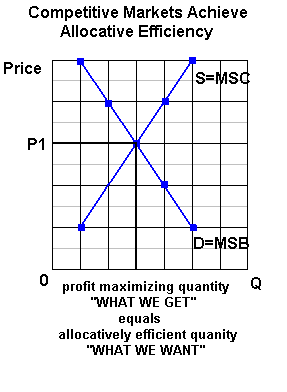
D. Competitive Markets and Allocative Efficiency (MSB=MSC)

1. if there are no negative externality (or spillover cost)s, then S = MSC,

2. if there are no positive externality (or spillover benefit)s, then D = MSB,

3. Graphically:

4. Then: WHAT WE GET = WHAT WE WANT and market economies achieve allocative efficiency


In a market economy with no positive externality (or spillover benefit)s and no negative externality (or spillover cost)s:

the profit maximizing or market equilibrium quantity
(what we get)

WILL BE THE SAME AS

the allocative efficient quantity
(what we want)
III. Economic Functions of Government

A. Five Reasons for Government Involvement
1. legal and social framework
2. maintaining competition
3. redistribution of income
(correcting market failure to achieve equity)
4. reallocation of resources
(correcting market failure to achieve efficiency)
5. stabilizing unemployment and inflation and promoting economic growth

B. Legal and Social Framework

providing the legal foundation and a social environment conducive to the effective operation of the market system

C. Maintaining Competition

1. review competition
a. large numbers
b. free entry and exit

2. the problem with monopolies

a. higher prices
b. smaller quantities
C. allocative and productive inefficiency

3. role of government

a. preventing monopolies -- antitrust laws
b. regulating monopolies -- natural monopolies

D. Correcting Market Failure to Achieve Equity

1. define equity
2. how does equity affect society's satisfaction?
3. examples of income distribution
US:http://www.census.gov/ftp/pub/hhes/income/histinc/h02.html
World:

4. role of government

a. transfer payments
b. market intervention
c. progressive income taxes

E. Correcting Market Failure to Achieve Allocative Efficiency

Arguing the Upside of High Gas Prices

Morning Edition, September 22, 2005

One writer believes gas prices actually should be high. Steve Inskeep talks with James Surowiecki, a financial columnist for The New Yorker who says a 50-cent gas tax would make drivers pay for the real cost of cars on the road and make business cater to the fuel-conscious.

http://www.npr.org/templates/story/story.php?storyId=4858826

1. Spillovers (or Externalities)

a. spillover costs
1) definition
2) examples
http://www.ryerson.ca/~ibryan/ecn104/wk9/lect9.html
3) markets and inefficiency
4) correcting for spillover costs
a) legislation
b) specific taxes
http://www.forces.com/pages/crs-tax.htm

5) failure to provide for the future

a) explanation
b) role of government

b. spillover benefits

1) definition
2) examples
3) markets and inefficiency
4) correcting for spillover benefits
a) increase demand
b) increase supply
c) government provision

c. public goods and services

1) definition
2) examples
3) markets and inefficiency
4) allocating resources to public goods

F. Stabilization

1. unemployment
2. inflation
3. role of government
a. fiscal policy
b. monetary policy