OUTLINE -- CHAPTER 2
The Economizing Problem: Making Choices
Lectures
2a Globalization
I. The Necessity of Choice -- Production Possibilities
A. The Economizing Problem -- The Necessity of ChoiceThe choices necessitated because society’s material wants for goods and services are unlimited but the resources available to satisfy these wants are limited.1. Unlimited Wants
2. Limited resourcesB. Production Possibilities -- Demonstrating the Necessity of Choice
1. Production Possibilities Tablea. shows the MAXIMUM POSSIBLE LEVELS OF PRODUCTION given the assumptions
b. assumptions1) fixed resources
2) fixed technology
3) productive efficiency
4) full employment
5) only two goodsc. the necessity of choice -- Unattainable combinations
2. Production Possibilities Curve
a. the necessity of choice -- Unattainable combinations
b. opportunity costs1) ALL costs in economics are opportunity costs
2) definitionThe amount of other products which must be forgone or sacrificed to produce a unit of a product.
3) examples
- coming to class today
- a Big Mac
- attending NIU
- "free" trip
- life?
4) calculating opportunity costs
c. law of increasing costs
1) definitionAs the production of a good increases the opportunity cost of producing an additional unit rises.
2) shape of the PPC -- concave
3) rationaled. unemployment
e. productive inefficiency
f. economic growth (Macro Issue)1) Two (Three) Definitions
- Increasing our ABILITY to Produce (Ch 2 Def.)
- causes
- more resources
- better resources
- better technology
- graphically
- "ABILITY"
- Increasing Output
- graphically
- caused by:
- reduce UE,
- or reduce. prod ineff.
- OR Ch. 2 Def. ???
- Increasing GDP per capita
- 2) a shrinking PPC?
3) non-proportional growthg. present choices, future possibilities
h. optimum product mix? (allocative efficiency?)
1. going to war
2. discrimination
3. growth: Japan vs. U.S.
4. international trade
5. other
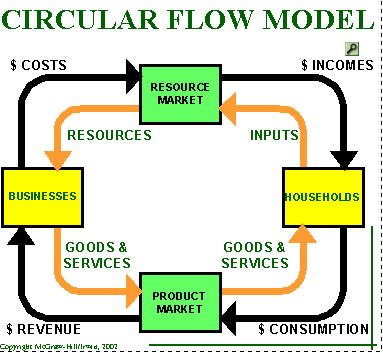
II. The Circular Flow Model
The flow of resources from households to firms and of products from firms to households. These flows are accompanied by reverse flows of money from firms to households and from households to firms.
A. Two Markets1. product marketA market in which products are sold by firms and bought by households.
a. how much to buy
b. how much to produce2. resource market
A market in which households sell and firms buy resources or the services of resources.
a. how many to hire
b. how much we earnB. Two Flows
1. real flow
2. money flowC. Reversal of Roles
D. Limitations